
In today’s digital economy, organisations rely heavily on technology to deliver services, communicate with customers, and maintain operations. Whether you are a small business, a nonprofit organisation, or a growing enterprise, unexpected disruptions can occur at any time. Cyber incidents, hardware failures, human error, natural disasters, and power outages all have the potential to halt operations.
This is where Business Continuity Planning (BCP) becomes essential.
A well-structured Business Continuity Plan ensures that your organisation can continue operating during and after a disruption, while protecting critical data, systems, and services.
What Is Business Continuity Planning?
Business Continuity Planning is the process of preparing an organisation to continue operating during disruptions by identifying risks, protecting critical systems, and defining clear response procedures.
A Business Continuity Plan typically outlines:
- Critical business systems and applications
- Key operational processes that must remain available
- Roles and responsibilities during an incident
- Data backup and recovery strategies
- Communication plans for staff, customers, and stakeholders
- Steps required to restore services within acceptable timeframes
Rather than reacting to incidents as they happen, BCP ensures organisations respond in a structured, prepared, and controlled manner.
This analysis helps define recovery priorities and acceptable downtime thresholds.
Why Business Continuity Planning Matters
Many organisations underestimate how quickly a disruption can impact operations.
For example:
- A ransomware attack could lock critical systems
- A server failure may stop access to business applications
- Cloud misconfigurations can interrupt customer services
- A power outage may shut down office operations
Without a Business Continuity Plan, recovery can take days or even weeks.
With a structured BCP in place, organisations can:
- Minimise operational downtime
- Protect important data and systems
- Maintain service delivery to customers and stakeholders
- Reduce financial and reputational damage
- Meet regulatory and governance requirements
For many Australian organisations, business continuity is now closely linked to cyber security frameworks such as the Essential Eight, which focus on strengthening resilience against cyber threats.
Key Components of an Effective Business Continuity Plan
A strong Business Continuity Plan goes beyond backups. It requires strategic planning across technology, people, and processes.
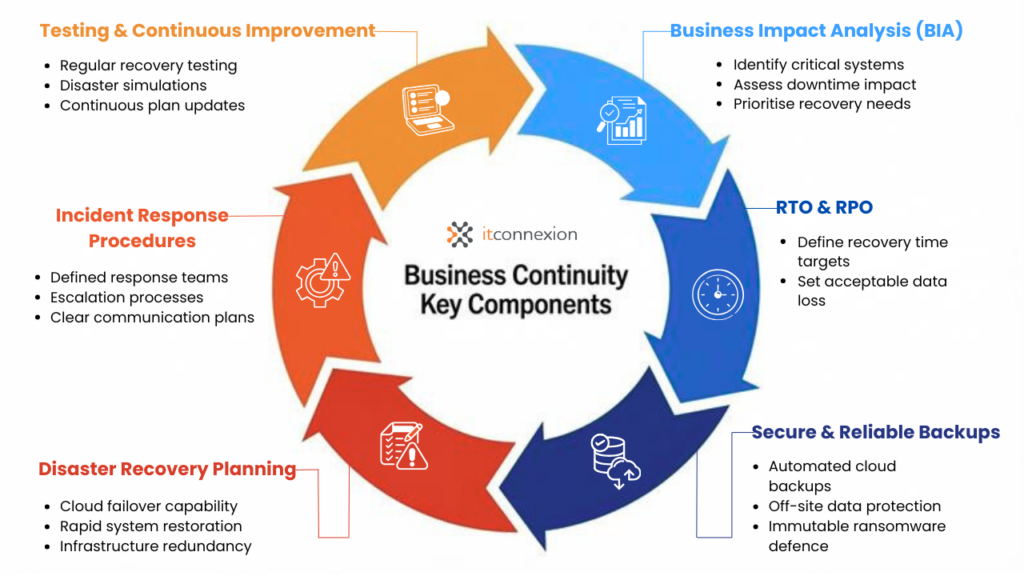
A Business Impact Analysis identifies:
- Which systems and services are critical
- How long the organisation can operate without them
- The operational and financial impact of downtime
Two key metrics guide recovery planning:
- Recovery Time Objective (RTO)
The maximum acceptable time to restore systems after a disruption. - Recovery Point Objective (RPO)
The maximum acceptable amount of data loss measured in time.
For example, a financial system may require an RTO of two hours and an RPO of fifteen minutes.
Backups remain a critical component of business continuity. Modern backup strategies should include:
- Automated backups
- Offsite or cloud storage
- Immutable backups protected from ransomware
- Regular backup testing and validation
Backups are only useful if they can be restored quickly and reliably.
Disaster Recovery (DR) focuses on restoring IT infrastructure and systems after major incidents. This may involve:
- Cloud failover environments
- Virtual server recovery
- Data replication
- Infrastructure redundancy
A Disaster Recovery Plan works alongside Business Continuity Planning to ensure both technology and business operations can be restored efficiently.
When an incident occurs, staff need clear instructions. A good BCP includes:
- Escalation procedures
- Defined response teams
- Incident communication processes
- Coordination with IT providers and cyber security teams
Prepared response plans significantly reduce confusion during critical situations.
Business Continuity Plans should never remain static. Regular testing ensures the plan works in real-world scenarios. This may include:
- Backup restoration testing
- Disaster recovery simulations
- Cyber incident tabletop exercises
- Operational continuity drills
Testing allows organisations to identify gaps and improve their response capabilities.
Business Continuity in the Australian Context
Australian organisations are increasingly facing cyber security threats, ransomware attacks, and operational disruptions.
Government frameworks such as the Essential Eight highlight the importance of resilience and preparedness.
Many organisations are also seeing business continuity requirements emerge from:
- Cyber insurance policies
- Regulatory compliance requirements
- Board and governance expectations
- Customer and supplier risk assessments
Business continuity is no longer viewed as optional. It is becoming a core part of organisational risk management.
How Managed IT Services Support Business Continuity
Implementing Business Continuity Planning requires technical expertise, monitoring capabilities, and ongoing maintenance.
Managed IT Service Providers (MSPs) can support organisations by providing:
- Business Continuity and Disaster Recovery planning
- Secure cloud infrastructure and redundancy
- Managed backup and recovery solutions
- Cyber security monitoring and incident response
- 24/7 infrastructure monitoring and support
These services help organisations build resilient, secure, and recoverable IT environments.
Building a Resilient Organisation
No organisation can eliminate every risk, but with the right preparation, the impact of disruptions can be significantly reduced.
A well-designed Business Continuity Plan ensures that when incidents occur, your organisation can continue delivering services, protect its reputation, and recover quickly.
Organisations that invest in continuity planning today are far better positioned to handle the challenges of tomorrow.
Need Help with Business Continuity Planning?
If your organisation does not yet have a Business Continuity Plan, or if your current plan has not been reviewed recently, it may be time to assess your readiness.
ITConnexion provides Managed IT Services, cyber security solutions, and business continuity planning to help Australian organisations build resilient and secure IT environments.
Contact ITConnexion today to discuss how we can help your organisation strengthen its Business Continuity strategy.